

UNEXPLAINED BRIGHTNESS FROM COLOSSAL EXPLOSION
UNEXPLAINED BRIGHTNESS FROM COLOSSAL EXPLOSION
Maunakea, Hawaii – Astronomers have discovered the brightest infrared light from a short gamma-ray burst ever seen, with a bizarre glow that is more luminous than previously thought was possible. Its half-second flash of light, detected in May of this year, came from a violent explosion of gamma rays billons of light-years away that unleashed more energy in a blink of an eye than the Sun will produce over its entire 10-billion-year lifetime.
The study has been accepted in The Astrophysical Journal and will be published online later this year. A pre-print is available on arXiv.org.
“It’s amazing to me that after 10 years of studying the same type of phenomenon, we can discover unprecedented behavior like this,” said Wen-fai Fong, assistant professor of physics and astronomy at Northwestern University and lead author of the study. “It just reveals the diversity of explosions that the universe is capable of producing, which is very exciting.”
NASA’s Hubble Space Telescope quickly captured the glow within just three days after the burst and determined its near-infrared emission was 10 times brighter than predicted, defying conventional models.
“These observations do not fit traditional explanations for short gamma-ray bursts,” said Fong. “Given what we know about the radio and X-rays from this blast, it just doesn’t match up. The near-infrared emission that we’re finding with Hubble is way too bright.”
To zero in on this new phenomenon’s exact brightness, the team used W. M. Keck Observatory on Maunakea in Hawaii to pinpoint the precise distance of its host galaxy.
“Distances are important in calculating the burst’s true brightness as opposed to its
apparent brightness as seen from Earth,” said Fong. “Just as the brightness of a light
bulb when it reaches your eye depends on both its luminosity and its distance from you,
a burst could be really bright because either it is intrinsically luminous and distant, or not
as luminous but much closer to us. With Keck, we were able to determine the true
brightness of the burst and thus the energy scale. We found it was to be much more
energetic than we originally thought.”
Using Keck Observatory’s Low Resolution Imaging Spectrometer (LRIS) and DEep
Imaging and Multi-Object Spectrograph (DEIMOS), the team determined the burst came
from a galaxy located at a redshift of z = 0.55 – quite a bit farther than the initial
calculated distance.
Lasting less than two seconds, short gamma-ray bursts are among the most energetic,
explosive events known; they live fast and die hard. Scientists think they’re caused by
the merger of two neutron stars, extremely dense objects about the mass of the Sun
compressed into the volume of a small city. A neutron star is so dense that on Earth,
one teaspoonful would weigh a billion tons!
Neutron star mergers are very rare and extremely important because scientists think
they are one of the main sources of heavy elements in the universe, such as gold and
uranium.
Along with a short gamma-ray burst, scientists expect to see a “kilonova” whose peak
brightness typically reaches 1,000 times that of a classical nova. Kilonovae are an
optical and infrared glow from the radioactive decay of heavy elements and are unique
to the merger of two neutron stars, or the merger of a neutron star and a black hole.
What Fong and her team saw was too bright to be explained even by a traditional
kilonova. They provide one possible explanation for the unusually bright blast. While
most short gamma-ray bursts probably result in a black hole, the neutron star merger in
this case may have instead formed a magnetar, a supermassive neutron star with a
very powerful magnetic field. The magnetar deposited a large amount of energy into the
ejected material of the kilonova, causing it to glow even brighter.
“What we detected even outshines the one confirmed kilonova discovered in 2017,” said
co-author Jillian Rastinejad, a graduate student with Fong’s team at Northwestern
University. “As a first-year graduate student working with real-time data for the first time
when this burst happened, it’s remarkable to see our discovery motivate a new and
exciting magnetar-boosted model.”
With such an event, the team expects the ejecta from the burst to produce light at radio
wavelengths in the next few years. Follow-up radio observations may ultimately prove
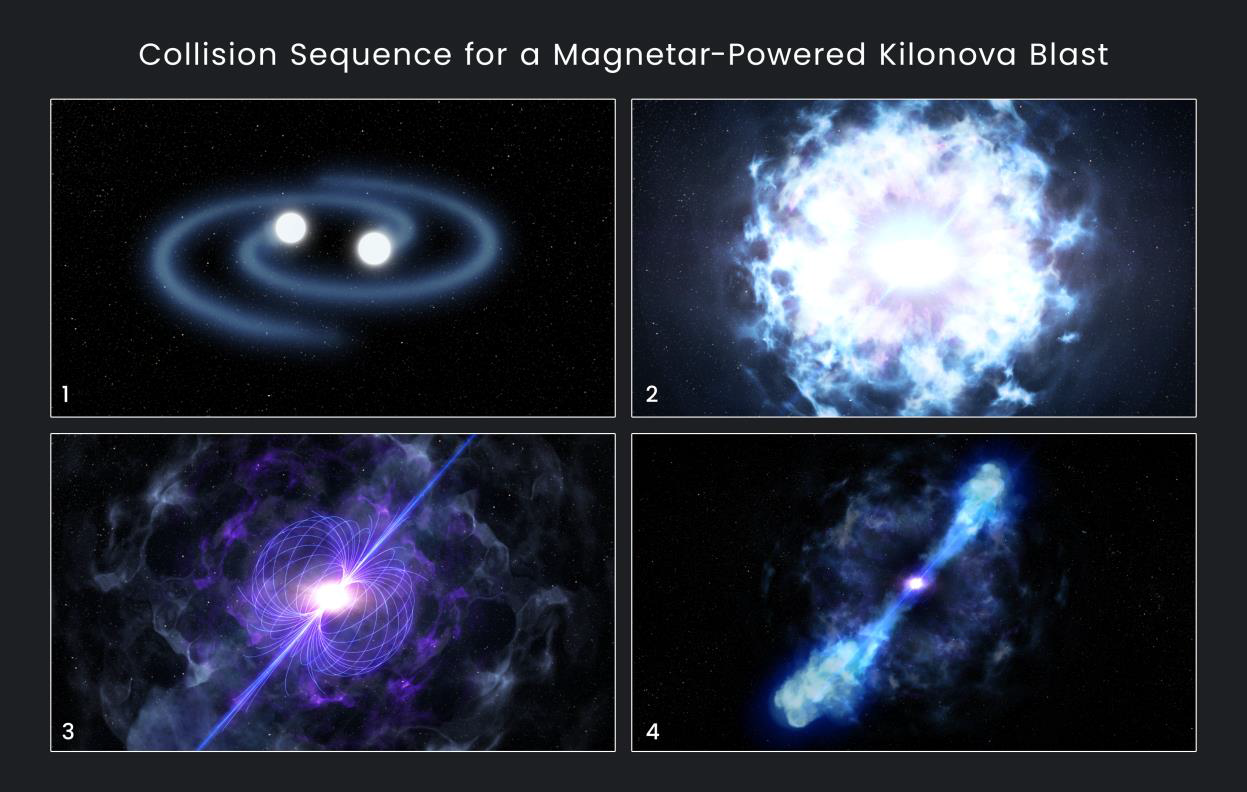
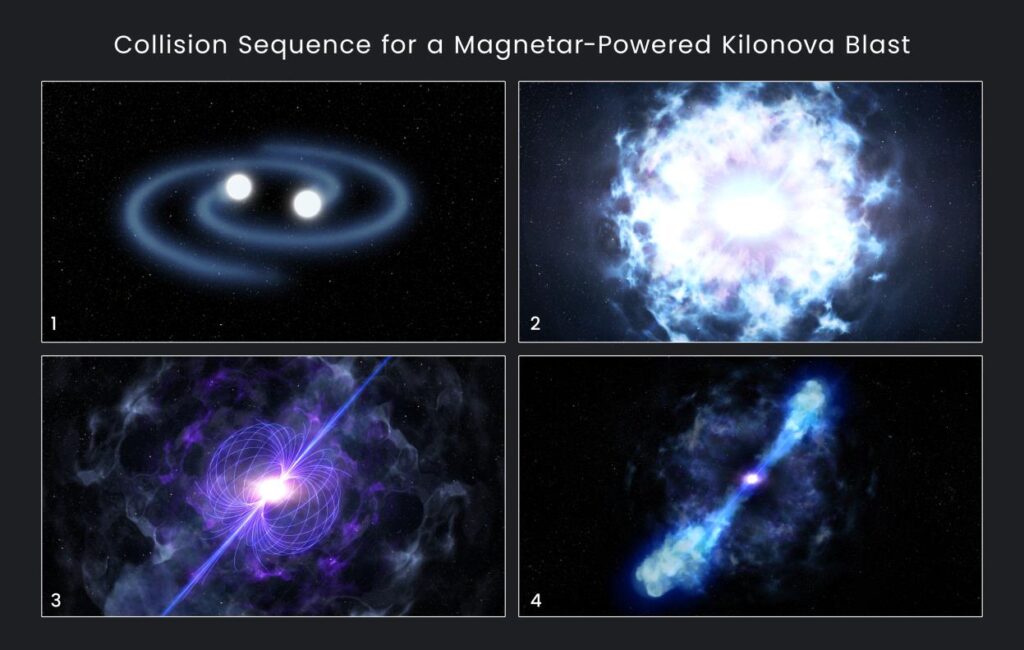
This illustration shows the sequence for forming a magnetar-powered kilonova, whose peak
brightness reaches up to 10,000 times that of a classical nova. 1) Two orbiting neutron stars
spiral closer and closer together. 2) They collide and merge, triggering an explosion that
unleashes more energy in a half-second than the Sun will produce over its entire 10-billion-year
lifetime. 3) The merger forms an even more massive neutron star called a magnetar, which has
an extraordinarily powerful magnetic field. 4) The magnetar deposits energy into the ejected
material, causing it to glow unexpectedly bright at infrared wavelengths.
Credit: NASA/ESA/D. Player, STScI
the origin of the burst was indeed a magnetar. The birth of a magnetar from a neutron
star merger has never definitively been seen before, as they are expected to be rare
outcomes.
The short gamma-ray burst was first detected with NASA’s Neil Gehrels Swift
Observatory. Once the alert went out, the team quickly enlisted other telescopes to
conduct multi-wavelength observations. They analyzed the afterglow in X-ray with Swift
Observatory, optical and near-infrared with Las Cumbres Observatory Global
Telescope, Hubble, and Keck Observatory, and in radio wavelengths with the Very
Large Array. This particular gamma-ray burst was one of the rare instances in which
scientists were able to detect light across the entire electromagnetic spectrum.
NASA’s upcoming James Webb Space Telescope is particularly well-suited for this type
of observation.
“We can’t wait to combine the power of Keck and JWST along with other facilities as a
team to go after even more enigmatic events like these,” said Keck Observatory Chief
Scientist John O’Meara. “This study shows that we have much left to learn.”
# # #
ABOUT LRIS
The Low Resolution Imaging Spectrometer (LRIS) is a very versatile and ultra-sensitive
visible-wavelength imager and spectrograph built at the California Institute of
Technology by a team led by Prof. Bev Oke and Prof. Judy Cohen and commissioned in
1993. Since then it has seen two major upgrades to further enhance its capabilities: the
addition of a second, blue arm optimized for shorter wavelengths of light and the
installation of detectors that are much more sensitive at the longest (red) wavelengths.
Each arm is optimized for the wavelengths it covers. This large range of wavelength
coverage, combined with the instrument’s high sensitivity, allows the study of everything
from comets (which have interesting features in the ultraviolet part of the spectrum), to
the blue light from star formation, to the red light of very distant objects. LRIS also
records the spectra of up to 50 objects simultaneously, especially useful for studies of
clusters of galaxies in the most distant reaches, and earliest times, of the
universe. LRIS was used in observing distant supernovae by astronomers who received
the Nobel Prize in Physics in 2011 for research determining that the universe was
speeding up in its expansion.
ABOUT DEIMOS
The DEep Imaging and Multi-Object Spectrograph (DEIMOS) boasts the largest field of
view (16.7arcmin by 5 arcmin) of any of the Keck Observatory instruments, and the
largest number of pixels (64 Mpix). It is used primarily in its multi-object mode, obtaining
simultaneous spectra of up to 130 galaxies or stars. Astronomers study fields of distant
galaxies with DEIMOS, efficiently probing the most distant corners of the universe with
high sensitivity.
ABOUT W. M. KECK OBSERVATORY
The W. M. Keck Observatory telescopes are among the most scientifically productive on
Earth. The two 10-meter optical/infrared telescopes on the summit of Maunakea on the
Island of Hawaii feature a suite of advanced instruments including imagers, multi-object
spectrographs, high-resolution spectrographs, integral-field spectrometers, and worldleading
laser guide star adaptive optics systems. Some of the data presented herein
were obtained at Keck Observatory, which is a private 501(c) 3 non-profit organization
operated as a scientific partnership among the California Institute of Technology, the
University of California, and the National Aeronautics and Space Administration. The
Observatory was made possible by the generous financial support of the W. M. Keck
Foundation. The authors wish to recognize and acknowledge the very significant
cultural role and reverence that the summit of Maunakea has always had within the
Native Hawaiian community. We are most fortunate to have the opportunity to conduct
observations from this mountain. For more information, visit:
www.keckobservatory.org


