

Hawaii: Today in History 6/26

1938-06-26 Neil Abercrombie, American politician (Rep-D-Hawaii, 1986-88), born in Buffalo, New York
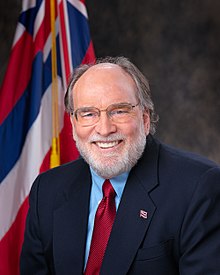
Neil Abercrombie (born June 26, 1938) is an American politician who served as the seventh governor of Hawaii from 2010 to 2014.[1] He is a member of the Democratic Party.
Born in Buffalo, New York, Abercrombie is a graduate of Union College (Schenectady, New York) and the University of Hawai’i at Mānoa. Abercrombie began his political career in 1975, after winning a seat in the Hawaii House of Representatives. He served in the Hawaii House until 1979, when he was elected to the Hawaii State Senate. Upon the resignation of Cecil Heftel, who resigned from the U.S. House of Representatives to run for governor, Abercrombie was elected to his vacant seat in a special election in 1986, but lost the Democratic primary for a full term on the same day. Abercrombie served the remainder of Heftel’s term until early January, 1987. He served on the Honolulu City Council from 1988 to 1990 before returning to Congress in 1991. Abercrombie served nine consecutive terms in the House from 1993 to 2010, representing Hawaii’s 1st congressional district, consisting of urban Honolulu.
Read more about him here: https://ballotpedia.org/Neil_Abercrombie
1997-06-26 Israel Kamakawiwo’ole, Native Hawaiian musician, entertainer and Hawaiian sovereignty advocate (Somewhere Over The Rainbow/What A Wonderful World), dies at 38
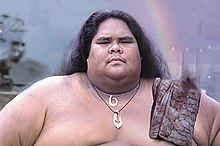
Israel Kaʻanoʻi Kamakawiwoʻole (Hawaiian pronunciation: [kəˌmɐkəˌvivoˈʔole], translation: “The Fearless Eyed Man”) (May 20, 1959 – June 26, 1997) also called Bruddah Iz or IZ, was a Native Hawaiian singer-songwriter, musician, and Hawaiian sovereignty activist.
His voice became famous outside Hawaii when his album Facing Future was released in 1993. His medley of “Somewhere Over the Rainbow/What a Wonderful World” was released on his albums Ka ʻAnoʻi and Facing Future. It was subsequently featured in several films, television programs, and television commercials.
Along with his ukulele playing and incorporation of other genres, such as jazz and reggae, Kamakawiwoʻole remains influential in Hawaiian music.
Throughout his life, Kamakawiwoʻole was super obese and at one point he weighed 757 pounds (343 kg; 54 st 1 lb) standing at 6 feet 2 inches (1.88 m) tall (body mass index = 97.2).[5] He endured several hospitalizations because of health problems. Beset with respiratory, heart, and other medical problems, he died at the age of 38 in Queen’s Medical Center at 12:18 a.m. on June 26, 1997. Kamakawiwoʻole was survived by his wife, Marlene Kamakawiwoʻole, and their daughter, Ceslie-Ann “Wehi”.
The Hawaii state flag flew at half-staff on July 10, 1997, the day of Kamakawiwoʻole’s funeral. His koa wood coffin lay in state at the state capitol building in Honolulu, the third person and the only non-government official to be so honored. Approximately ten thousand people attended the funeral. Thousands of fans gathered as his ashes were scattered into the Pacific Ocean at Mākua Beach on July 12, 1997. According to witnesses, many people on land commemorated him by honking their car and truck horns on all Hawaiian highways that day. Scenes from the funeral and scattering of Kamakawiwoʻole’s ashes were featured in official music videos of “Over the Rainbow” released posthumously by Mountain Apple Company. As of April 2019, the two videos as featured on YouTube have collectively received over 790 million views.
On September 20, 2003, hundreds paid tribute to Kamakawiwoʻole as a bronze bust (located at 21.45008°N 158.19092°W) of the revered singer was unveiled at the Waianae Neighborhood Community Center on Oʻahu. The singer’s widow, Marlene Kamakawiwoʻole, and sculptor Jan-Michelle Sawyer were present for the dedication ceremony.


